Manufacturing
How Glass Perfume Bottles Are Made: Step by Step
Understanding production helps buyers judge quality, lead time and what can be customized.
Get a Quote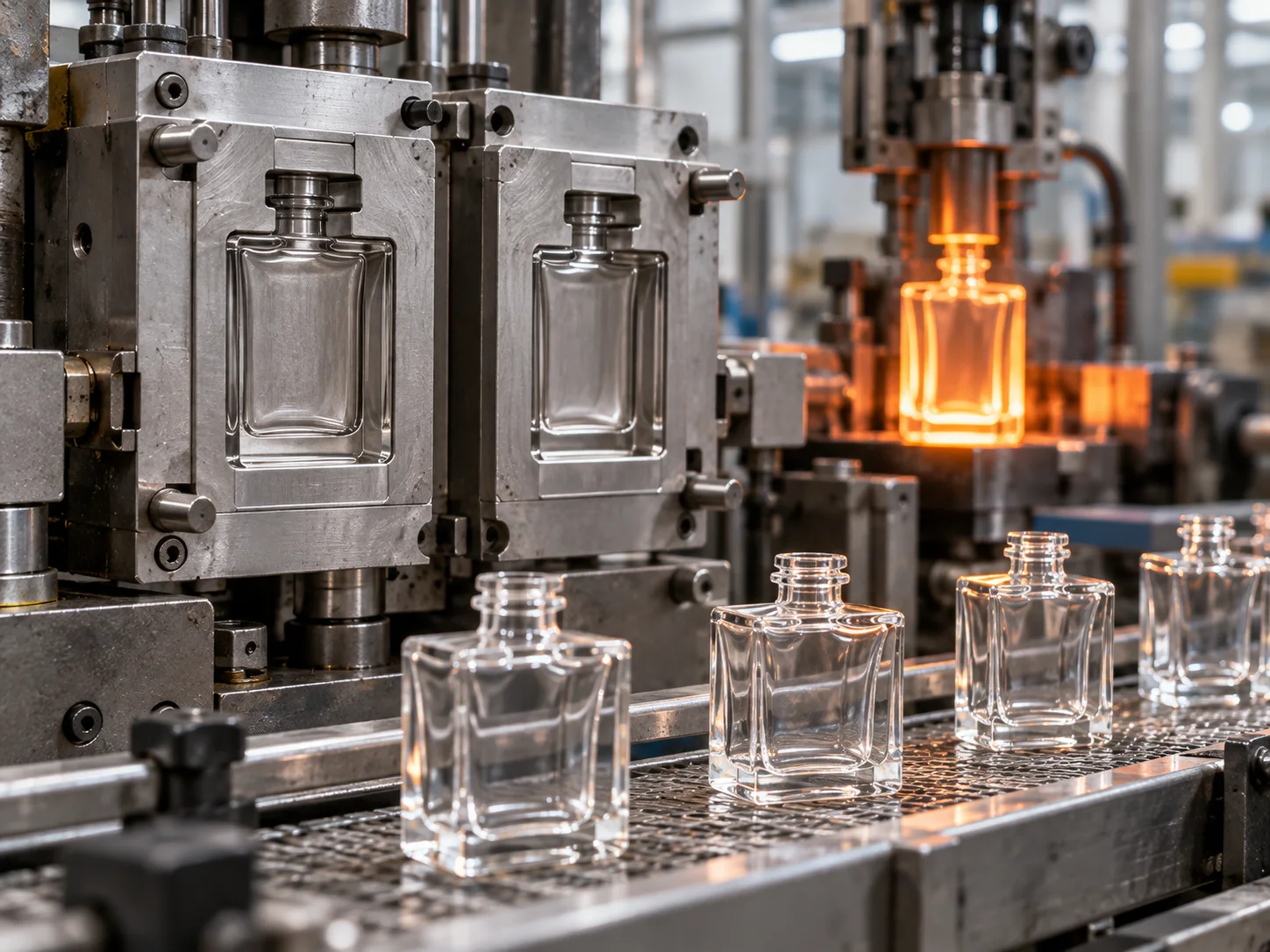
Raw materials and batching
Glass perfume bottles are made primarily from soda-lime glass. Sand, soda ash, limestone and other materials are weighed and mixed into a batch that determines clarity and color. Colored glass can be produced in the melt, while clear bottles are often color-coated later for flexibility.
Melting and refining
The batch is melted and refined in a furnace at high temperature, where bubbles and defects are removed. The temperature and viscosity of the molten glass are controlled before it is fed to the forming machines.
Forming
A measured gob of molten glass is delivered into a bottle mold. On the forming line it is blown (or pressed and blown) into the bottle shape. The mold defines the silhouette, base and neck, and is machined and maintained to reproduce the bottle accurately.
Annealing
Newly formed bottles are hot and under internal stress. They pass through an annealing lehr that heats and then slowly cools them, removing stress and improving strength. Skipping or rushing this step can leave bottles prone to cracking.
Inspection
Bottles are inspected for cracks, stones, bubbles, mold marks and dimensional errors before decoration. Neck and capacity are checked because they affect the cap, pump and fill.
Decoration
Approved bottles are decorated by screen printing, hot foil, spray coating, frosting, electroplating or labels, then cured or processed as the method requires. Decoration is tested for adhesion and alcohol resistance before shipment.
Final QC and packing
Finished bottles are inspected, packed in partitioned export cartons and palletised. You can see the full line and each zone on the production process guide and factory tour pages.